
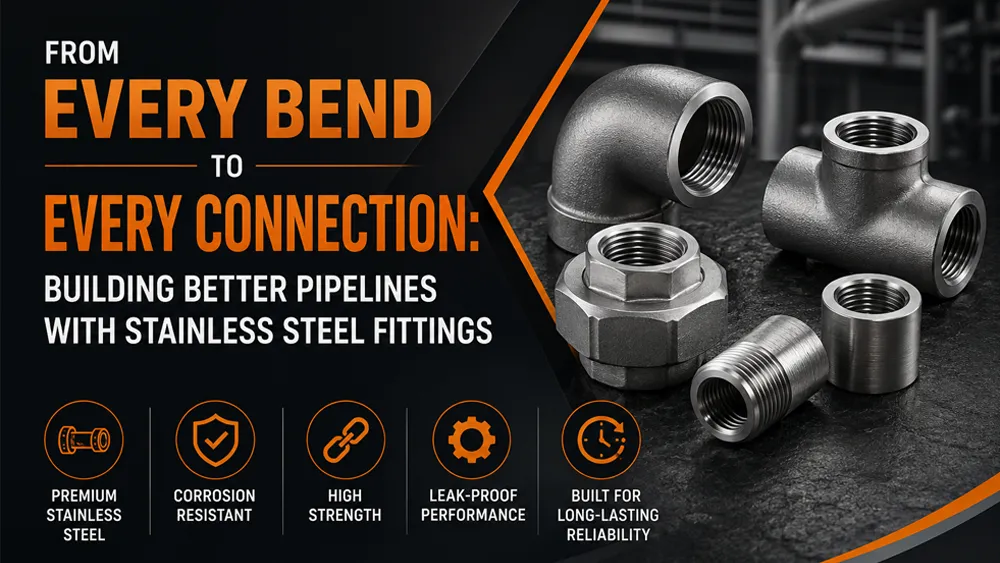
A pipeline is only as strong as its worst joint. You can spec the best pipe on the market and weld it in perfectly, and still end up with a system that fails early because someone went cheap on the elbows and tees holding it together. Fittings don't get much attention. They're usually where the real engineering actually happens.
Every bend and branch is a point where flow direction changes and pressure shifts. The fitting absorbs that. A badly made one doesn't just underperform quietly, it's usually the first thing to go, and it tends to pick the worst possible moment to do it.
Grade and manufacturing quality matter more here than almost anywhere else in the system.
Choosing between these grades is critical to preventing premature pitting and system wear:
Standard choice for water systems, food and beverage lines, HVAC, and general structural work. It holds up exceptionally well under normal atmospheric conditions and is highly cost-effective.
Contains added molybdenum, offering supreme resistance to chlorides, aggressive acids, marine air, seawater, chemical processing, offshore rigs, and pharmaceutical applications.
Get this wrong and it's expensive. A SS 304 pipe fitting sitting in a chloride-heavy environment can start pitting within months, way before anything else on the line shows wear. Sourcing SS 316 pipe fittings is the standard safeguard in aggressive applications.
Forging, seamless drawing, and welding—all of these can introduce a weak spot if nobody's watching closely. Wall thickness has to stay even around a bend. Weld seams need full penetration and proper heat treatment after, or the fitting becomes exactly the failure point you were trying to avoid. Dimensional accuracy matters too. A fitting slightly off spec throws alignment off for the whole run, and every joint downstream inherits that stress.
Two fittings can sit next to each other on a shelf, look identical, and perform completely differently once they're in the ground. The difference is almost always in how carefully they were made.
When choosing a supply partner, ensure they provide:
Steelage Alloys LLP manufactures and stocks stainless steel pipe fittings and flanges such as elbows, tees, reducers, stub ends, and caps in both 304 and 316, with in-house testing and over 20 years of supply history across India and international markets. Whether you need an SS 304 or SS 316 pipe fittings for a standard industrial run, Steelage Alloys LLP is a trusted SS 304 and SS 316 pipe fittings manufacturer and supplier in India.
Not a great idea for critical sections; mixing grades can trigger galvanic corrosion at the joint. It is always better to match the fitting grade to the pipe grade across the whole run.
You can't, really. They look identical. It must be confirmed through mill certs or material testing, which is exactly why supplier documentation matters.
It can be, if done correctly and if it is treated properly with heat treatment. However, seamless fittings will always get the nod when high pressure is critical.
A high-performing pipeline relies completely on the integrity of its fittings. High-quality stainless steel elbows, tees, and flanges form the backbone of industrial safety, ensuring stress absorption and chemical durability. By selecting the correct grade and checking supplier test certificates, plants can prevent unforeseen shutdowns and achieve long-term efficiency.
Partnering with a reliable manufacturing expert ensures the fittings supplied match international standards and compliance requirements. For grade selection assistance and customized estimates, get in touch with Steelage Alloys LLP today.