
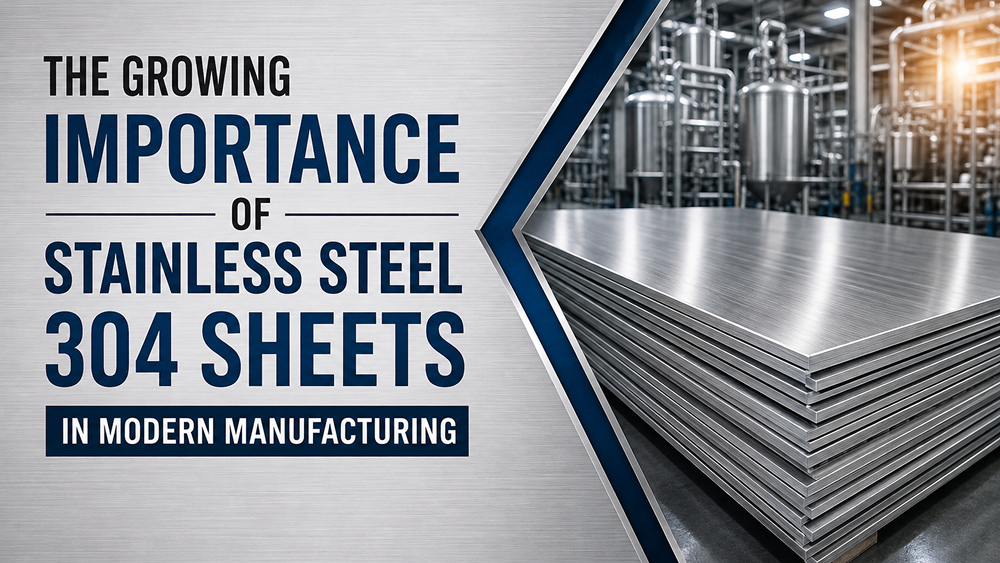
Select any ten objects at random from a contemporary kitchen, hospital or factory shop-floor, and there is a good possibility that three or four of them were formed using the stainless steel 304 sheet.
The reason that SS 304 sheet has gained its popularity is not down to any one characteristic, but rather the combination of all its features. This grade offers corrosion resistance, satisfactory strength, good welding and forming qualities, and affordability which does not make buyers run a mile like other grades tend to. This is why the same coil of steel can be utilized to produce anything from chemical tanks to domestic sinks in kitchens.
Containing about 18% chromium and 8% nickel, the stainless steel 304 sheet is corrosion-resistant in most normal conditions and does not need to have the additional molybdenum, which makes 316 superior to be used in conditions with salt or chemicals. That’s basically the only reason why 304 can be used in completely unrelated situations. It's good enough for most jobs without being over-built, or overpriced, for any single one of them.
In industrial settings, these sheets get pushed hard. Chemical processing plants use them for tanks, piping supports, and equipment housings, in places where a spill or constant moisture would eat through mild steel in a matter of months. Pharmaceutical manufacturers rely on it for equipment surfaces because it doesn't react with the products being processed, and it's easy to sanitize, with no pitting or corrosion sites where bacteria can hide.
Food and beverage plants lean on SS 304 for the same hygiene reasons, plus the fact that it holds up to aggressive washdown cycles run every single day. Processing tanks, conveyor frames, and prep surfaces all need a material that won't leach anything into food and won't corrode under constant cleaning. It covers both without needing a premium grade.
Building construction utilizes type Stainless Steel 304 for structural cladding, railings, and architectural façades not only because of its aesthetic appeal but also because it can endure weathering without much maintenance over decades. However, in coastal and highly polluted environments, one may need to use 316, while 304 is sufficient for other constructions.
Step outside the factory and SS 304 is still there, just quieter about it. Kitchen sinks, cookware, cutlery, countertop appliances — almost all of it is 304. Handrails and elevator panels in office buildings, medical instruments, water bottles, even some furniture frames. Same grade, different job every time.
Part of why it travels so well between industries is that it's genuinely easy to work with. It cuts, bends, and welds without the fuss some higher grades demand, and it takes a range of finishes — mirror, brushed, mill — depending on whether the end product needs to look good or just needs to hold up. A fabricator can move from an industrial job to a decorative one without switching materials or retooling much in between.
The fact that it can be recycled without degradation is also a major plus point for consumers who care about such features more today than they did a decade ago. The longevity of its use, often in the range of several decades without much maintenance, helps make it a low-impact option despite the initial price not being the lowest.
Steelage Alloys LLP is dedicated to supplying premium quality stainless steel 304 sheets tailored to exact project dimensions and industry standards across India and global markets.
Barely, and only slightly more so after cold working like bending or rolling. In its normal annealed state, it's close to non-magnetic.
316 has added molybdenum, which gives it better resistance to chlorides and saltwater. 304 works fine for most indoor and general outdoor use where that extra resistance isn't needed.
Yes, in most climates. In coastal or heavily industrial areas with constant salt or chemical exposure, 316 is usually the safer call.
304 keeps showing up across such different industries because one grade genuinely covers a wide range of needs without forcing a compromise most projects can't live with. A hospital can't gamble on hygiene. A chemical plant can't gamble on corrosion. A cookware brand doesn't want to explain to customers why their pans are rusting.
That's why sourcing matters almost as much as the grade itself. A stainless steel 304 sheet supplier that stocks a real range of thicknesses and finishes, and backs the material with proper mill certificates, saves a project from delays before it even starts. At Steelage Alloys, that's mostly what we spend our time on: making sure what leaves the warehouse actually matches what the job calls for.