
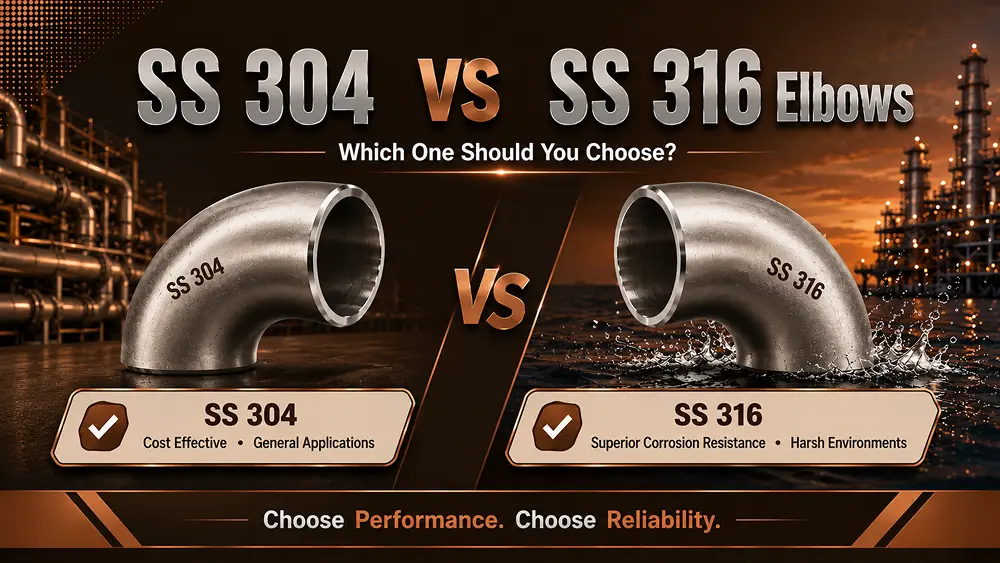
Stainless steel elbows are essential piping components used across various industrial applications. However, choosing the right material grade for these fittings can be a challenge. Two of the most widely used grades are SS 304 and SS 316. Understanding their differences in composition, performance, and cost is key to making an informed decision for your project.
Stainless steel elbows are pipe fittings used to change the direction of flow in piping systems. They are commonly available in angles like 45*, 90*, and 180*, and are used in industries such as oil & gas, chemical processing, food processing, and construction.
Two of the most popular materials used for these fittings are SS 304 and SS 316 due to their excellent corrosion resistance and strength.
The main difference between SS 304 and SS 316 lies in their chemical composition. Grade 316 contains molybdenum, whereas Grade 304 does not. Below is the technical breakdown:
| Element / Grade | SS 304 Grade | SS 316 Grade | Key Function of Element |
|---|---|---|---|
| Chromium (Cr) | 18% to 20% | 16% to 18% | Provides basic corrosion resistance and oxidation resistance. |
| Nickel (Ni) | 8% to 10.5% | 10% to 14% | Improves ductility, toughness, and resistance to acids. |
| Molybdenum (Mo) | - | 2% to 3% | Significantly boosts resistance to chlorides and pitting. |
| Other Elements | Fe, Mn, Si, C, P, S | Fe, Mn, Si, C, P, S | Balance of material mechanical properties. |
Corrosion resistance is one of the most important factors when selecting pipe fittings. The difference determines their suitability for aggressive environments:
Both SS 304 and SS 316 elbows are strong, durable, and easily weldable, but they have slight mechanical variations:
Project budget and material availability are key elements when determining which grade to procure:
Due to their differing material strengths, their industrial deployments split as follows:
Selecting the correct elbow fitting material is crucial to balance longevity and cost. Follow this quick decision path:
Both SS 304 and SS 316 elbows are excellent choices for piping systems, but selecting the right one depends on your application, environment, and budget. While SS 304 offers affordability and versatility, SS 316 stands out for its superior corrosion resistance and durability in extreme conditions.
If you are working in industries like chemical processing, marine, or pharmaceuticals, investing in SS 316 elbows can save you from long-term maintenance and replacement costs. On the other hand, for general industrial use, SS 304 elbows provide a reliable and economical solution.