
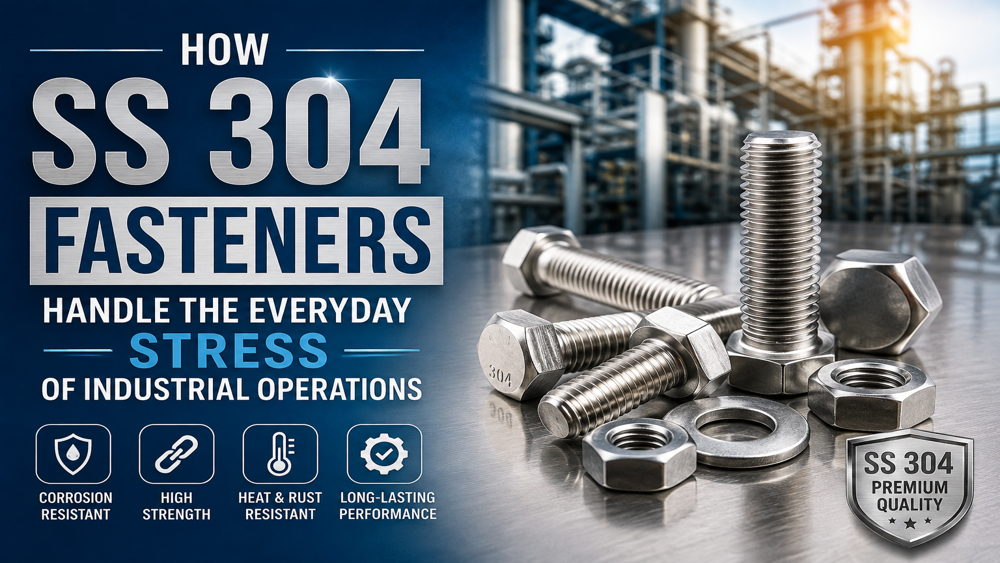
Failing does not happen suddenly in machines. It is always a process that happens gradually, a little bit at a time, as the vibration gradually loosens a joint, as the corrosion gradually wears down a thread and breaks it, as the temperatures slowly damage connections which were fine in every check. This is where fasteners come in.
SS 304 fasteners have earned their place across manufacturing plants, processing facilities, and structural installations because they hold up to exactly this kind of everyday operational stress. They're not the flashiest component in any assembly, but they're often the one quietly determining how long that assembly stays reliable.
Steelage Alloys manufactures Stainless Steel 304 fasteners built for this kind of demanding, continuous industrial use, and as a leading SS 304 Fasteners manufacturer in India, the company works with facilities to make sure the fastener grade actually matches the operational stress it's expected to handle.
Industrial environments put fasteners through a combination of stresses that rarely show up in isolation. Running machinery causes vibrations, process heat results in temperature changes, chemical and moisture attacks, and mechanical stresses are among the various environmental conditions acting on the joint at once. The weakness in such a combination is a fastener that performs perfectly in one condition but poorly in the other.
One of the benefits of using it is the anti-corrosive properties that it has. This happens due to the presence of chromium in the stainless steel, which creates a passive oxide coating over its surface.
In the case of fasteners that work with moisture, humidity, cleaning process and other industrial applications, it becomes a very useful feature in comparison to regular carbon steel fasteners.
However, it should not be considered suitable for every environment. Highly aggressive chemicals, high chloride exposure, and certain marine or chemical processing conditions may require a different stainless steel grade. Application conditions should always be evaluated before selecting the fastener material.
Industrial machinery often generates vibration. Motors, pumps, conveyors, compressors, and rotating equipment can subject fastened joints to repeated mechanical forces.
These fasteners can contribute to reliable assemblies when correctly specified and installed. However, the performance of a joint depends on more than the fastener material alone. Thread engagement, joint design, preload, tightening torque, washer selection, and the type of loading all influence joint reliability.
There can be considerable differences in temperature in industrial settings. Machinery may get heated when in use and cooled when stopped.
Temperature fluctuations may lead to expansion and contraction of the connected parts. Correct fastening joint design will have to account for these fluctuations while maintaining appropriate levels of clamping force.
It is an excellent choice of material under various industrial temperature conditions. Still, the actual suitability will have to depend on the operating temperature, loads, and surroundings.
A fastener's job does not end once installation is complete. It needs to maintain the connection throughout the service life of the equipment.
These fasteners can support long-term reliability by combining corrosion resistance with the mechanical properties required for many general industrial assemblies. Their stainless steel construction can also provide a clean appearance, which is useful in applications where both functionality and appearance matter.
Reliable manufacturing is equally as important. Dimensional precision, quality of threads, surface conditions, and materials are all aspects that may affect performance within an assembly.
Not every fastener performs identically simply because it carries the same grade designation. Manufacturing controls have an important influence on the finished product.
An established SS 304 Fasteners manufacturer in India should maintain appropriate controls over raw material selection, dimensions, threading, surface quality, and inspection. Consistency becomes particularly important when fasteners are purchased in large quantities for production lines or major industrial projects.
For procurement teams, checking technical specifications, applicable standards, material documentation, and quality processes can help reduce the risk of inconsistent fastener performance.
It is suitable for numerous general industrial applications, although it is advisable to check whether this material meets your particular conditions of exposure. In cases of high exposure to chloride, such as coastal and marine areas, 316 material may suit your needs better. In case of general industrial applications and limited outdoor exposure, Stainless Steel 304 usually performs well and is more affordable.
| Condition | SS 304 | SS 316 |
|---|---|---|
| General industrial use | ✓ Suitable | ✓ Suitable |
| Moisture & humidity exposure | ✓ Suitable | ✓ Suitable |
| High chloride / coastal areas | ⚠ Evaluate carefully | ✓ Preferred |
| Marine environments | ✗ Not recommended | ✓ Recommended |
| Limited outdoor exposure | ✓ Performs well | ✓ Performs well |
| Cost consideration | ✓ More affordable | ⚠ Higher cost |
Yes, it is suitable for outdoor use, although SS 316 is more desirable in environments with chloride exposure.
It provides superior corrosion protection and lacks the coating that may eventually wear away.
Yes, they are made with correct tolerances of the threads.
The everyday stress of industrial operations rarely announces itself. It builds quietly through vibration, temperature change, and corrosion exposure, and the fasteners holding an assembly together determine whether that stress leads to failure or gets absorbed without incident. These fasteners, manufactured to the right standard, handle that stress reliably across a wide range of industrial applications.
Steelage Alloys, recognized as a leading SS 304 Fasteners manufacturer in India, works with facilities to specify and supply fasteners suited to their actual operational demands. In case fastener reliability has always been a problem in your operation, it may be important for you to evaluate the grade and quality of your existing fasteners.